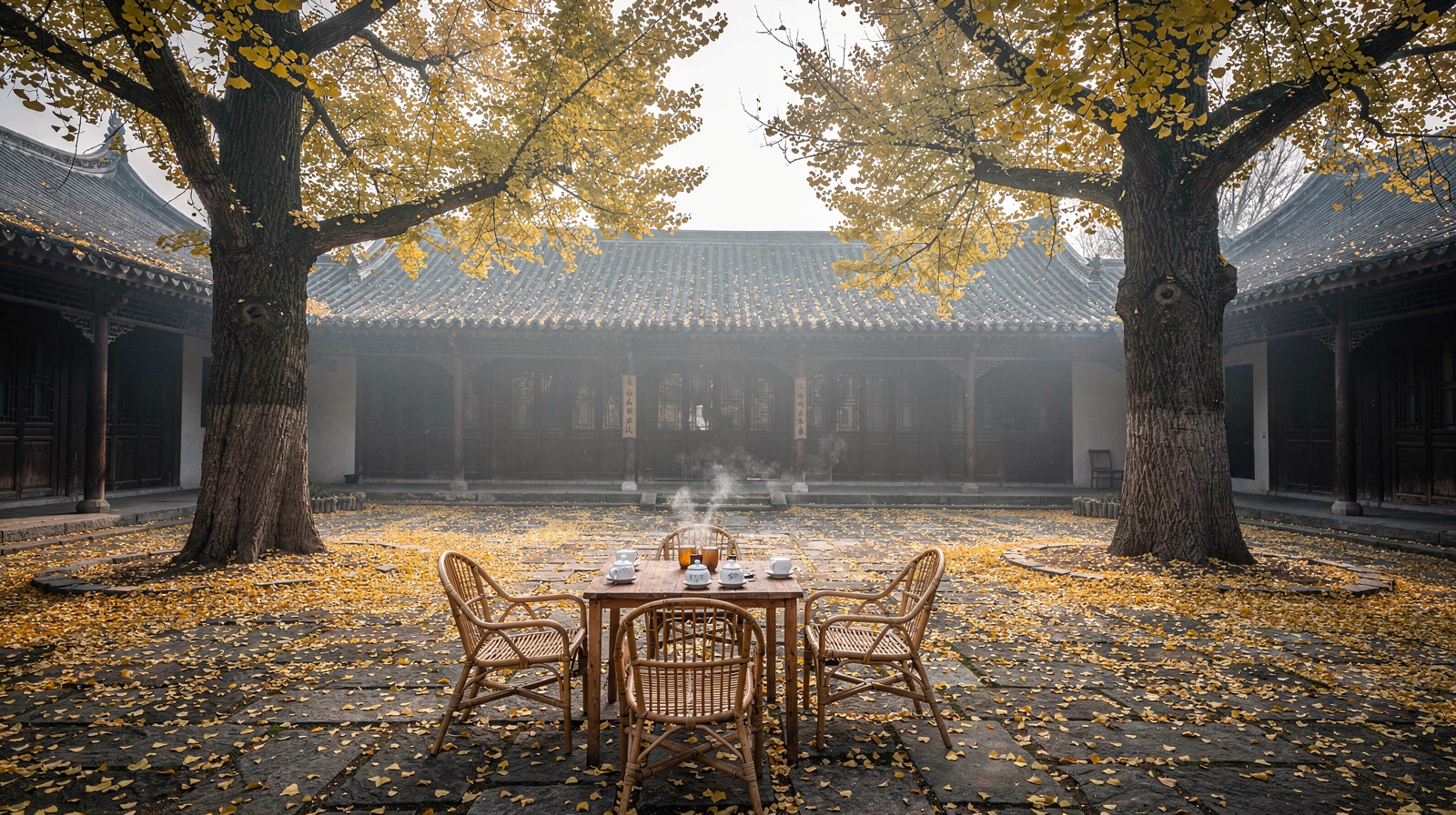
At half past six in the morning, before the city’s traffic has properly started, the bamboo chairs by the lake in People’s Park are already filling. There are men with newspapers, women with knitting, and pairs of retirees who look as if they have sat at the same table for thirty years. At that hour a lidded bowl of tea costs about three yuan, and someone comes round with a kettle to top it up for as long as you care to stay. Lonely Planet put Chengdu in Best in Travel 2027 for its “tea houses, street style and laid-back attitude”, and the teahouse is where that attitude is easiest to see.
Late autumn is when to see it. The city’s old ginkgo trees start turning in mid-November and are usually at their brightest from the last week of November into mid-December, when temple courtyards and campus lanes go yellow underfoot. The light is soft and grey. Expect 10–16°C in November and close to freezing at night by December, so pack layers rather than sunglasses. There is also a deadline. British and most EU passport holders can currently enter China without a visa for up to 30 days, but the scheme as it stands ends on 31 December 2026, and no extension had been announced by mid-October.
Tea before the city wakes up
Heming Teahouse has been on the lake in People’s Park since 1923. The park was Chengdu’s first public park, opened in 1911 on the site of the old Manchu garrison, and it has its own stop on Metro Line 2. The early-morning price is the bargain. Later in the day the tea costs more but is still cheap, and the hot water is still free. This guide to Heming and the park explains how it works, including the ear-cleaners who move between the tables with long metal picks. That costs about ¥30–40, and they will try to sell you extras. In November the park also puts on a chrysanthemum show with more than 500 varieties.
For an older teahouse, take a Didi about 40 minutes south-west to Pengzhen, out towards Shuangliu airport. The Guanyin Pavilion teahouse opens around five in the morning. A cup costs about ¥2 and a bottomless thermos about ¥10, and the room has become a favourite with photographers from all over China. Museum of Wander’s account of Pengzhen is right to say it is the regulars’ room and you are a guest. Order tea, sit down, and ask before you raise a camera.
The gold weeks
Wenshu Monastery is the place to start in ginkgo season. Entry is free, it has its own station on Line 1, and its century-old trees stand over courtyards that smell of incense. In winter (November to March) the gates open from 8:00 to 17:30. The monastery has a teahouse and a well-known vegetarian restaurant. Five minutes’ walk away on Wenshuyuan Street, Zhang Lao Er has been serving sweet-water noodles, thick and coated in a sweet chilli-and-garlic sauce, since 1944.
After that, follow the city’s own map. Each autumn Chengdu publishes a ginkgo viewing guide, and last year’s edition marked more than ten spots. Among them were Wangjiang Tower beside Sichuan University’s riverside campus, the Wenshu Fang lanes, and the old trees at Wuhou Shrine (¥50), which joins straight onto Jinli Ancient Street. Kuanzhai Xiangzi, the three restored Qing-era lanes near People’s Park, is pretty in yellow too, but go between 8 and 11am. After that it becomes what China Highlights frankly calls a “Chengdu culture experience theme park”.
Eating past the chilli
Chengdu was UNESCO’s first City of Gastronomy, in 2010. The 2027 Michelin guide, announced in September, gave the city its first three-star restaurant. It went to Xin Rong Ji, which cooks the food of Taizhou on the Zhejiang coast, not Sichuan. Sichuan cooking’s highest award in the guide is Yu Zhi Lan’s two stars.
Most of what people eat here comes from much smaller kitchens. Cang ying guan zi, literally “fly restaurants”, are tiny places, often without a sign, where a bowl of dan dan noodles costs ¥10–20. Goldthread’s street-food guide is a good starting list, including Chen Mapo Tofu, which says it invented the dish (it has several branches now). For an evening of snacks, take Line 6 to Jianshe North Road and walk the middle section of Jianshe Road after 5pm for rabbit head, chao shou wontons in chilli oil and Zhong dumplings. Accidental Travel Writer’s round-up of Sichuan restaurants covers the sit-down options, and hotpot at the big local chains runs about ¥100–180 a head. If you have an allergy, read Wander in China’s food guide first: a split hotpot does not keep ingredients apart, and kung pao chicken has peanuts all the way through.
Pandas at eight
The Chengdu Research Base of Giant Panda Breeding started in 1987 with six rescued pandas and now takes up to 85,000 visitors a day. There is no ticket window. You book online with your real name, up to 14 days ahead, and show the same passport at the gate. Adult tickets are ¥55. From November to February the gates open at 8:00, and the morning feed between 8:00 and 9:30 is when the pandas are awake and eating. By mid-morning most are asleep. This guide to timing a visit says November is the base’s quietest month, with that summer’s cubs a few months old. The base is about 15 km from the centre, so leave early.
Out of town by train
The Leshan Giant Buddha is 71 metres tall and was carved into the cliff above the meeting of the Min and Dadu rivers over about ninety years in the Tang dynasty. High-speed trains from Chengdu East or Chengdu South take 50–60 minutes. A walking ticket is ¥80. A ¥70 boat ticket gets you the whole statue in one view without the queue for the cliff stairs. Get there at opening.
Closer in, the Dujiangyan irrigation system has controlled the Min River since about 256 BC and still works. Mount Qingcheng, next to it, is one of the places where Taoism began. Trains for both leave from Xipu, at the end of Metro Line 2, and cost about ¥10. Check the timetable on the day.
Two videos before you go, one on the tea and one on the noodles:
Exploring Chengdu's Legendary Teahouses - Traditional & Modern Tea Culture in China | Tea Trip
Mei Leaf
I ate 20 BOWLS of noodles in Chengdu - these are the places you NEED to go!
Blondie in China
Wenshu, not Chunxi Road
Most first-timers book near Chunxi Road and Taikoo Li, the shopping district. For a trip built around tea and ginkgos, stay up in the Wenshu Fang lanes instead. The monastery, its teahouse and the sweet-water noodles are on your doorstep, it is quieter and cheaper, and Line 1 runs straight down through Tianfu Square. The Buddha Zen Hotel has courtyard rooms right beside the monastery, at mid-range prices or less (there’s no lift). For a splurge, Upper House Chengdu, which traded as The Temple House until its 2025 rebrand, has 100 rooms around a restored courtyard next to Daci Temple, with the Michelin Green Star Mi Xun Teahouse on site. Shangri-La Chengdu, on the Jinjiang river near Anshun Bridge, is the reliable middle option. Wander in China’s neighbourhood guide compares the areas.
A few things worth knowing about China right now
Long-haul flights land at Tianfu (TFU), 51 km south-east of the city. The Line 18 express metro reaches Chengdu South in about half an hour. Flights from Hong Kong moved back to the older Shuangliu airport (CTU) this summer, so check the three-letter code on your ticket. The two airports are about 50 km apart, and changing between them means collecting your bags and checking in again. Air China flies direct from London Gatwick (seasonally) and from Brussels, and there are direct flights from Paris, Milan, Madrid, Vienna and Athens. Turkish Airlines starts flying from Istanbul on 11 November. There is nothing direct from Amsterdam. Before you fly, link a card to Alipay or WeChat Pay, because almost nobody uses cash and bank text-message verification can fail once you are in China. If your trip runs into 2027, check the visa rules again before booking. The 240-hour visa-free transit still covers UK and EU travellers, but only as a fallback.
Ten weeks are left on the visa-free scheme as it stands, and the ginkgos peak inside them. The panda-base booking rules, the Pengzhen teahouse, Jianshe Road’s snack stalls, three places to stay near Wenshu and the Leshan train are all in our Chengdu collection. Save it, and be in People’s Park while the tea still costs three yuan.
This guide was curated using Epic Itineraries — save links from anywhere on the web, organise them into collections, and turn research into itineraries.