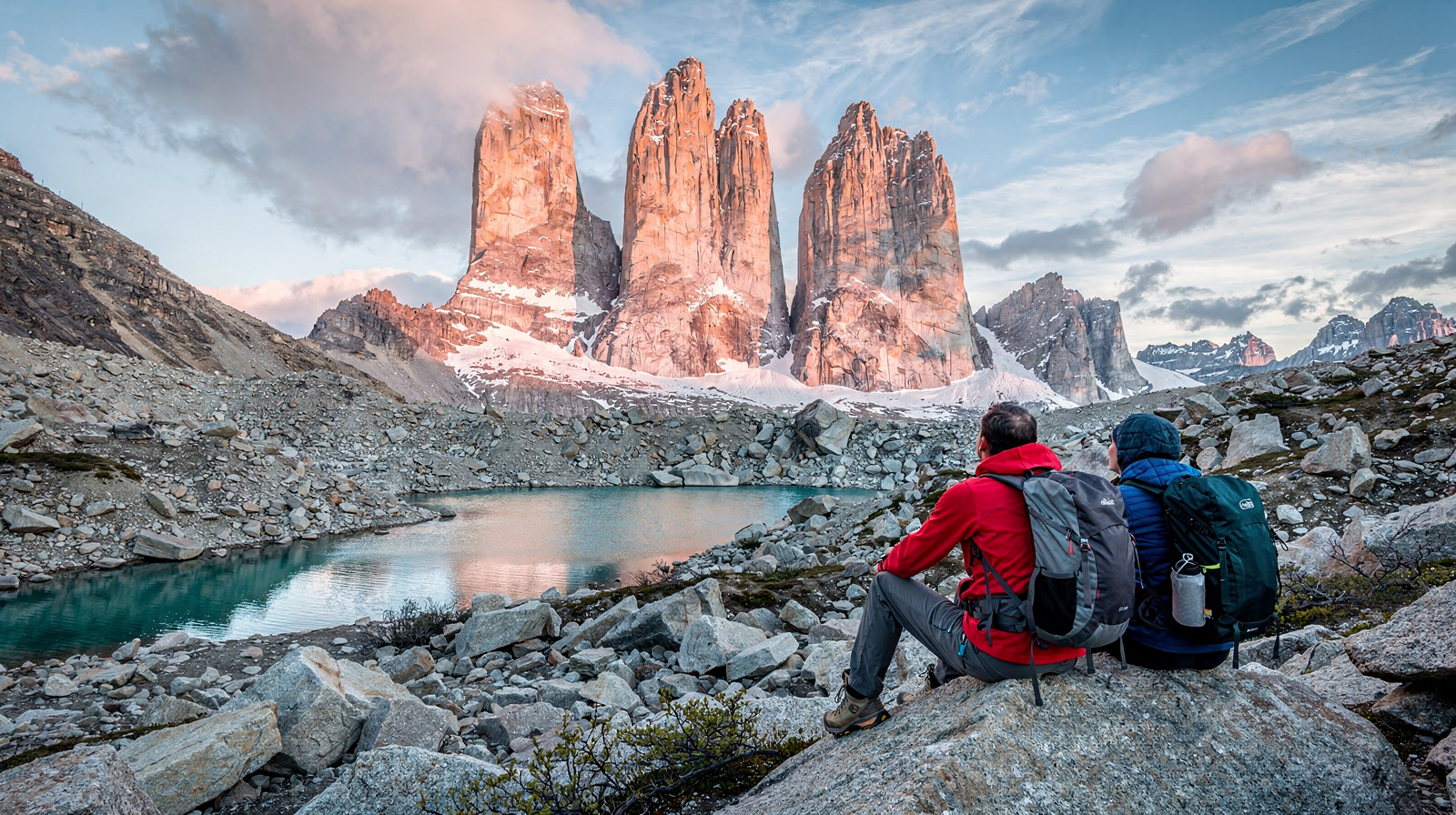
The last hour up to the towers isn’t a path so much as a moraine, a slope of grey boulders you pick your way across in the dark with a head torch. Then the ground levels out at a small green lake, and three granite spires stand straight up out of the far side of it. If the sky is clear, the first light turns them orange for about ten minutes. That view is the reason most people come to Torres del Paine, and walking there gets easier this season. Since 16 September, CONAF, the Chilean park service, no longer requires a guide on the W or on the trail to Base Torres. The winter rules are finished and the spring has begun.
What hasn’t changed is the rule that decides everything else: you can’t sleep in the park’s backcountry without a confirmed booking for every night. Last season CONAF’s three free campsites, Torres, Italiano and Paso, stayed closed all year, and there’s been no word that they’ll reopen. So every bed and every pitch on the W is now sold by one of two companies, and the ones for December to February are already going. A late-spring trip is the way round that.
The W, and why November
The W is 72 kilometres of trail, walked over four or five days, in the shape its name suggests. It runs along the south side of the Paine massif, with three detours up into the valleys. The Base Torres climb is the eastern arm. The middle one goes up the Valle del Francés to the hanging glaciers under Paine Grande. The western arm follows Lago Grey to the face of the glacier. The highest point is only 850 metres, but the weather makes up for it. Nomades’ W Trek guide, updated at the start of September, is the best single account of how the days fit together and in which direction to walk.
October is possible, but not everything is open yet. Last season, going by CONAF’s own 2025–26 park newsletter, Central and Chileno opened on 1 October, Paine Grande and Grey the same day, and Cuernos not until 1 November. By November the whole W is running, the days are long, the guanacos have young, and the summer crowds haven’t arrived. Spring days swing between about 4°C and 15°C, and EcoCamp’s weather guide is honest about how fast they turn.
Take that seriously. On 17 November last year, a blizzard on the O circuit caught hikers near John Gardner Pass, and five of them died. ExplorersWeb’s timeline is sobering reading and worth your time before you pack. The park’s response shapes this season. The O, the full loop round the back of the massif, stays closed until 31 October. It’s planned to reopen on 1 November with a cap of 100 hikers a day, one-way walking and compulsory registration, and the pass itself opens only when CONAF judges it safe. The W has no pass that high, but a spring storm can shut any trail at short notice. Pack for four seasons, and leave a spare day at the end.
Booking every night
The park is split between two concessionaires. Las Torres Patagonia runs the eastern and central camps, Central, Chileno, Cuernos, Francés and Serón. Its self-guided four-day W Express starts at USD 1,450 per person in a fully equipped tent, and that includes meals, the park fee, the catamaran and transfers from Puerto Natales. Vertice runs the western side, with Paine Grande, Grey, Dickson and Los Perros, and its beds and pitches are cheaper if you carry your own gear. Wanderlust Designers keeps a clear map of which company runs which site, updated this month. Book the Central and Chileno nights first, because they’re the bottleneck for Base Torres.
Buy your park entry online, on the official Pases Parques portal. Since May it has sold two kinds of ticket, a day pass or up to ten consecutive days. At the end of September it listed a foreign adult at CLP 32,400 for a day and CLP 48,500 for the multi-day pass. That’s well below the CLP 80,000 some papers reported last winter, so check the price on the day you buy.
Not walking it all
You don’t need a tent to see the park. Base Torres works as a long day hike from the Laguna Amarga ranger station. Last season the latest start in October and November was 09:30, and everyone had to be off the lookout by 15:00, so set off early. The short walks to Salto Grande and Mirador Cuernos give you the massif without the climb. On the western side, the Grey III boat from Hotel Lago Grey takes about two and three-quarter hours up to the glacier face, pisco sour included. The Pehoé catamaran links Pudeto with Paine Grande for people walking the W from west to east.
Then there are the pumas. The best tracking is on the private estancias on the park’s eastern edge, Laguna Amarga and Cerro Guido, with guides on foot and no off-roading. Swoop’s puma-tracking guide explains how it’s done responsibly, and why the ranchers now put up with the cats. Keep your distance, never block a cat’s route, and don’t go with anyone who promises you a sighting.
Refugio, dome or Puerto Natales
Inside the park, EcoCamp Patagonia has geodesic domes, from simple shared-bath ones to lofted suites, and guided W departures every Monday from October to April. Hotel Las Torres sits at the Base Torres trailhead and sells all-inclusive stays of two to five nights from USD 2,590. At the top end, Explora on Lago Pehoé and Tierra Patagonia charge four figures a night and include the guiding.
Most people base themselves in Puerto Natales, a couple of hours’ drive from the park. The Singular occupies a 1915 cold-storage plant on the Señoret Channel, now a national monument, with its old machinery left in place. NOI Indigo is on the waterfront in town and has a spa for the day you get back. Weskar is a lenga-wood lodge a little way along the shore.
Natales also eats far better than a trekking town needs to. Lenga cooks contemporary Patagonian food over fire. Café Kaiken has been run by the same couple since 2005 and is known for its home-made pasta. Chile Nativo’s round-up adds Santolla, which serves king crab in converted shipping containers, Baguales, the town’s first brewpub, and Holasté, a coffee bar that made a world top-hundred list.
The trail, on screen
A day-by-day walk of the W with trail maps, and five day hikes for anyone who’d rather sleep in a bed:
W TREK, TORRES DEL PAINE (2025) | Hiking Guide to the W Trek In Patagonia, Chile (with Trail Maps)
World Wild Hearts
Torres del Paine: Top 5 Day Hikes WITHOUT Camping!
Adventures of Lauren & Jason
The logistics
From Europe you fly to Santiago, then south, either to Punta Arenas all year round, followed by about three hours on the Bus-Sur coach to Puerto Natales, or straight into Puerto Natales on the seasonal spring and summer flights. If you’re combining Chile with Argentina’s Perito Moreno glacier, El Calafate to Natales is about six hours by bus across the border at Cerro Castillo. Minimalist Journeys describes the crossing in detail: Chile X-rays every bag, and fresh food gets confiscated.
Four weeks until the O reopens, and the Central and Chileno nights are going now. The W Express booking page, the official ticket portal, the refugio map, the Grey glacier boat, the puma-tracking guide and the best tables in Puerto Natales are all in our Torres del Paine collection. Save it, book your nights before your flights, and be on the moraine with a head torch when the towers catch the light.
This guide was curated using Epic Itineraries — save links from anywhere on the web, organise them into collections, and turn research into itineraries.